Document text
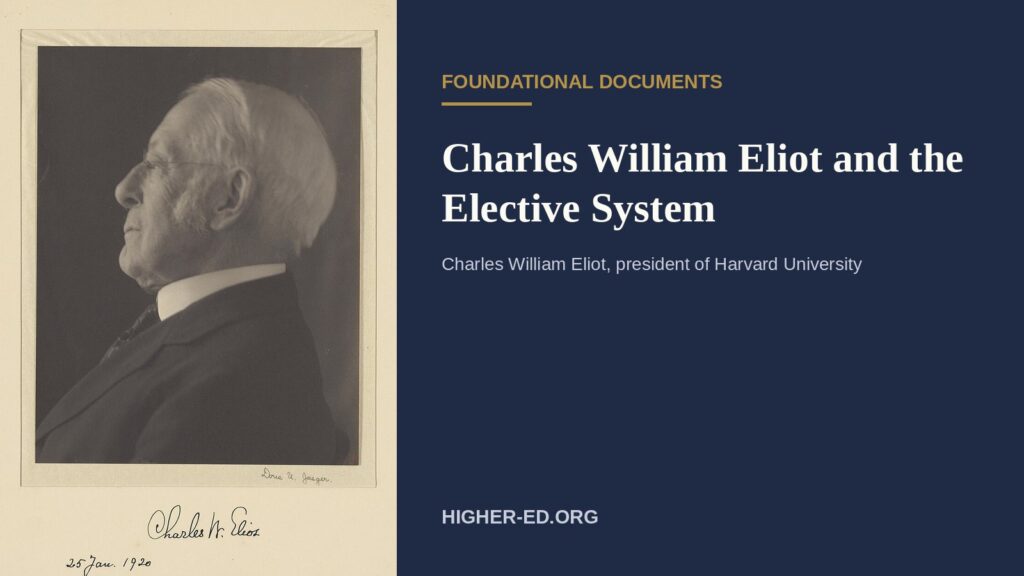
CHARLES WILLIAM ELIOT, The Elective System, 1885
How to transform a college with one uniform curriculum into a university without any prescribed course of study at all is a problem which more and more claims the attention of all thoughtful friends of American learning and education. To-night I hope to convince you that a university of liberal arts and sciences must give its students three things: (1) Freedom in choice of studies, (2) Opportunity to win academic distinction in single subjects or special lines of study, (3) A Discipline which distinctly imposes on each individual the responsibility of forming his own habits and guiding his own conduct. These three subjects I shall take up in succession, the first of them taking the greater part of the time allotted me. 1. Of freedom in choice of studies.
Let me first present what I may call a mechanical argument on this subject. A college with a prescribed curriculum must provide, say, sixteen hours a week of instruction for each class, or sixty-four hours a week in all for the four classes, without allowing for repetitions of lectures or lessons. Six or eight teachers can easily give all the instruction needed in such a college, if no repetitions are necessary. If the classes are so large that they need to be divided into two or more sections, more teachers must be employed. If a few extra or optional studies, outside of the curriculum, are provided, a further addition to the number of teachers must be made. Twenty teachers would, however, be a liberal allowance for any college of this type; and accordingly there are hundreds of American colleges at this moment with less than twenty teachers all told. Under the prescribed system it would be impossible for such a college to find work for more teachers, if it had them. Now there are eighty teachers employed this year in Harvard College, exclusive of laboratory assistants; and these eighty teachers give about four hundred and twenty-five hours of public instruction a week without any repetitions, not counting the very important instruction which many of them give in laboratories. It is impossible for any undergraduate in his four years to take more than a tenth part of the instruction given by the College; and since four fifth of this instruction is of a higher grade than any which can be given in a college with a prescribed curriculum, a diligent student would need about forty years to cover the present field; and during those years the field would enlarge quite beyond his powers of occupation. Since the student cannot take the whole of the instruction offered, it seems to be necessary to allow him to take a part. A college must either limit closely its teaching, or provide some mode of selecting studies for the individual student. The limitation of teaching is an intolerable alternative for any institution which aspires to become a university; for a university must try to teach every subject, above the grade of its admission requirements, for which there is any demand; and to teach it thoroughly enough to carry the advanced student to the confines of present knowledge, and make him capable of original research. These are the only limits which a university can properly set to its instruction-except indeed those rigorous limits which poverty imposes. The other alternative is selection or election of studies.
The elective system at Harvard has been sixty years in developing, and during fourteen of these years-from 1846 to 1860-the presidents and the majority of the faculty were not in favor of it; but they could find no way of escape from the dilemma which I have set before you. They could not deliberately reduce the amount of instruction offered, and election of studies in some degree was the inevitable alternative.
The practical question then is, At what age, and at what stage of his educational progress, can an American boy be offered free choice of studies? Or, in other words, At what age can an American boy best go to a free university? Before answering this question I will ask your attention to four preliminary observations.
- The European boy goes to free universities at various ages from seventeen to twenty; and the American boy is decidedly more mature and more capable of taking care of himself than the European boy of like age.
- The change from school to university ought to be made as soon as it would be better for the youth to associate with older students under a discipline suited to their age, than with younger pupils under a discipline suited to theirs-as soon, in short, as it would be better for the youth to be the youngest student in a university than the oldest boy in a school. The school might still do much for the youth; the university may as yet be somewhat too free for him: there must be a balancing of advantages against disadvantages; but the wise decision is to withdraw him betimes from a discipline which he is outgrowing, and put him under a discipline which he is to grow up to. When we think of putting boy into college, our imaginations are apt to dwell upon the occasional and exceptional evil influences to which his new freedom will expose him, more than upon those habitual and prevailing influences of college companionship which will nourish his manliness and develop his virtue; just as we are apt to think of heredity chiefly as a means of transmitting vices and diseases, whereas it is normally the means of transmitting and accumulating infinitely various virtues and serviceable capacities.
- A young man is much affected by the expectations which his elders entertain of him. If they expect him to behave like a child, his lingering childishness will oftener rule his actions; if they expect him to behave like a man, his incipient manhood will oftener assert itself. The pretended parental or sham monastic regime of the common American college seems to me to bring out the childishness rather than the manliness of the average student; as it evidenced by the pranks he plays, the secret societies in which he rejoices, and the barbarous or silly customs which he accepts and transmits. The conservative argument is: a college must deal with the student as he is; he will be what he has been, namely, a thoughtless, aimless, lazy, and possibly vicious boy; therefore a policy which gives him liberty is impracticable. The progressive argument is: adapt college policy to the best students, and not to the worst; improve the policy, and in time the evil fruits of a mistaken policy will disappear. I would only urge at this point that a far-seeing educational policy must be based upon potentialities as well as actualities, upon things which may be reasonably hoped for, planned, and aimed at, as well as upon things which are.
- The condition of secondary education is an important factor in our problem. It is desirable that the young men who are to enjoy university freedom should have already received at school a substantial training, in which the four great subdivisions of elementary knowledge-languages, history, mathematics, and natural science-were all adequately represented; but it must be admitted that this desirable training is now given in very few schools, and that in many parts of the country there are not secondary schools enough of even tolerable quality. For this condition of secondary education the colleges are in part responsible; for they have produced few good teachers, except for the ancient languages; and they have required for admission to college hardly anything but the elements of Greek, Latin, and mathematics. But how should this condition of things affect the policy of an institution which sees its way to obtain a reasonable number of tolerably prepared students: Shall we stop trying to create a university because the condition of secondary education in the country at large is unsatisfactory? The difficulty with that policy of inaction is that the reform and development of secondary education depend upon the right organization and conduct of universities. It is the old problem: Which was first created, an egg or a hen? In considering the relation of college life to school life, many people are confused by a misleading metaphor-that of a building. They say to themselves: on weak foundations no strong superstructure can be built; schools lay the foundations on which the university must build; therefore, if preparatory schools fail to do good work, no proper university work can subsequently be done. The analogy seems perfect, but has this fatal defect: education is a vital process, not a mechanical one. Let us, therefore, use an illustration drawn from a vital function, that of nutrition. A child has had poor milk as an infant, and is not well developed; therefore, when its teeth are cut, and it is ready for bread, meat, and oatmeal, you are to hold back this substantial diet, and give it the sweetened milk and water, and Mellin’s Food, which would have suited it when a baby. The mental food of a boy has not been as nourishing and abundant as it should have been at school; therefore when he goes to college or university his diet must be that which he should have had at school, but missed. Education involves growth or development from within in every part; and metaphors drawn from the process of laying one stone upon another are not useful in educational discussions. Harvard College now finds itself able to get nearly three hundred tolerably prepared students every year from one hundred or more schools and private tutors scattered over the country; and she is only just beginning to reap the fruit of the changes in her own policy and discipline which the past eighteen years have wrought. Schools follow universities, and will be what universities make them.
With these preliminary suggestions I proceed to answer the question, At what age can an American boy best go to a university where choice of studies is free? and to defend my answer. I believe the normal age under reasonably favorable conditions to be eighteen. In the first place, I hold that the temperament, physical constitution, mental aptitudes, and moral quality of a boy are all well determined by the time he is eighteen years old. The potential man is already revealed. His capacities and incapacities will be perfectly visible to his teacher, or to any observant and intimate friend, provided that his studies at school have been fairly representative. If his historical studies have been limited to primers of Greek, Roman, and American history, his taste and capacity for historical study will not be known either to his teacher or to himself; if he has had no opportunity to study natural science, his powers in that direction will be quite unproved; but if the school course has been reasonably comprehensive, there need be no doubt as to the most profitable direction of his subsequent studies. The boys future will depend greatly upon the influences, happy or unhappy, to which he is subjected; but given all favorable influences, his possibilities are essentially determined. The most fortunate intellectual influences will be within his reach, if he has liberty to choose the mental food which he can best assimilate. Secondly, at eighteen the American boy has passed the age when a compulsory external discipline is useful. Motives and inducements may be set vividly before him; he may be told that he must do so and so in order to win something which he desires or values; prizes and rewards near or remote may be held out to him; but he cannot be driven to any useful exercise of his mind. Thirdly, a well-instructed youth of eighteen can select for himself-not for any other boy, or for the fictitious universal boy but for himself alone-a better course of study than any college faculty, or any wise man who does not know him and his ancestors and his previous life, can possibly select for him. In choosing his course he will naturally seek aid from teachers and friends who have intimate knowledge of him, and he will act under the dominion of that intense conservatism which fortunately actuates civilized man in the whole matter of education, and under various other safeguards which nature and not arbitrary regulation provides. When a young man whom I never saw before asks me what studies he had better take in college, I am quite helpless, until he tells me what he likes and what he dislikes to study, what kinds of exertion are pleasurable to him, what sports he cares for, what reading interests him, what his parents and grandparents were in the world, and what he means to be. In short, I can only show him how to think out the problem for himself with such lights as he has and nobody else can have. The proposition that a boy of eighteen can choose his own studies, with the natural helps, more satisfactorily than anybody else can choose them for him, seems at first sight absurd; but I believe it to be founded upon the nature of things, and it is also for me a clear result of observation. I will state first the argument from the nature of things, and then describe my own observations.
Every youth of eighteen is an infinitely complex organization, the duplicate of which neither does nor ever will exist. His inherited traits are different from those of every other human being; his environment has been different from that of every other child; his passions, emotions, hopes, and desires were never before associated in any other creature just as they are in him; and his will-force is aroused, stimulated, exerted, and exhausted in ways wholly his own. The infinite variety of form and feature, which we know human bodies to be capable of, presents but a faint image of the vastly deeper diversities of the minds and characters which are lodged in these unlike shells. To discern and take due account of these diversities no human insight or wisdom is sufficient, unless the spontaneous inclinations, natural preferences, and easiest habitual activities of each individual are given play. It is for the happiness of the individual and the benefit of society alike that these mental diversities should be cultivated, not suppressed. The individual enjoys most that intellectual labor for which he is most fit; and society is best served when every man’s peculiar skill, faculty, or aptitude is developed and utilized to the highest possible degree. The presumption is, therefore, against uniformity in education, and in favor of diversity at the earliest possible moment. What determines that moment? To my thinking, the limit of compulsory uniform instruction should be determined by the elementary quality and recognized universal utility of the subjects of such instruction. For instance, it is unquestionable that every child needs to know how to read, write, and, to a moderate extent, cipher. Therefore primary schools may have a uniform programme. One might naturally suppose that careful study of the mother-tongue and its literature would be considered a uniform need for all youth; but as a matter of fact there is no agreement to this effect. The English language and literature have hardly yet won a place for themselves in American schools. Only the elements of two foreign languages and the elements of algebra and geometry can be said to be generally recognized as indispensable to the proper training of all young people who are privileged to study beyond their seventeenth year. There is no consent as to the uniform desirableness of the elements of natural science, and there is much difference of opinion about the selection of the two foreign languages, the majority of educated people supposing two dead languages to be preferable, a minority thinking that living languages are permissible. The limit of that elementary knowledge, of which by common consent all persons who are to be highly educated stand in need, is therefore a narrow one, easily to be reached and passed, under respectable instruction, by any youth of fair ability before he is eighteen years old. There, at least, ceases justifiable uniformity in education. There, at least, election of studies should begin; and the safest guides to a wise choice will be the taste, inclination, and special capacity of each individual. When it comes to the choice of a profession, everybody knows that the only wisdom is to follow inclination. In my view, the only wisdom in determining those liberal studies which may be most profitably pursued after eighteen is to follow inclination. Hence it is only the individual youth who can select that course of study which will most profit him, because it will most interest him. The very fact of choice goes far to secure the cooperation of his will.
I have already intimated that there exist certain natural guides and safeguards for every youth who is called upon in a free university to choose his own studies. Let us see what these natural aids are. In the first place, he cannot help taking up a subject which he has already studied about where he left it off, and every new subject at the beginning and not at the middle. Secondly, many subjects taught at the university involve other subjects, which must therefore be studied first. Thus, no one can get far in physics without being familiar with trigonometry and analytic geometry; chemical analysis presupposes acquaintance with general chemistry, and paleontology acquaintance with botany and zoology; no one can study German philosophy to advantage unless he can read German, and no student can profitably discuss practical economic problems until he has mastered the elementary principles of political economy. Every advanced course, whether in language, philosophy, history, mathematics, or science, presupposes acquaintance with some elementary course or courses. Thirdly, there is a prevailing tendency on the part of every competent student to carry far any congenial subject once entered upon. To repress this most fortunate tendency is to make real scholarship impossible. So effective are these natural safeguards against fickleness and inconsecutiveness in the choice of studies, that artificial regulation is superfluous.
I give, in the next place, some results of my own observation upon the working of an elective system; and that you may have my credentials before you I will describe briefly my opportunities of observation. I had experience as an undergraduate of a college course almost wholly required; for I happened upon nearly the lowest stage to which the elective system in Harvard College ever fell, after its initiation in 1825. During the nine years from 1854 to 1863 I became intimately acquainted with the working of this mainly prescribed curriculum from the point of view of a tutor and assistant professor who had a liking for administrative details. After a separation from the University of six years, two of which were spent in Europe as a student and four at the Massachusetts Institute of Technology as a professor, I went back as president in 1869 to find a tolerably broad elective system already under way. The wishes of the governing boards and external circumstances all favoring it, the system was rapidly developed. Required studies were gradually abolished or pushed back; so that first the Senior year was made completely elective, then the Junior, then the Sophomore, and finally in June last the Freshman year was made chiefly elective. No required studies now remain except the writing of English, the elements of either French or German (one of these two languages being required for admission), and a few lectures on chemistry and physics. None of the former exclusive staples, Greek, Latin, mathematics, logic, and metaphysics, are required, and no particular combinations or selections of courses are recommended by the faculty. I have therefore had ample opportunity to observe at Harvard the working of almost complete prescription, of almost complete freedom, and of all intermediate methods. In Europe I studied the free university method; and at the Institute of Technology I saw the system-excellent for technical schools-of several well-defined courses branching from a common stock of uniformly prescribed studies.
The briefest form in which I can express the general result of my observation is this: I have never known a student of any capacity to select for himself a set of studies covering four years which did not apparently possess more theoretical and practical merit for his case than the required curriculum of my college days. Every prescribed curriculum is necessarily elementary from beginning to end, and very heterogeneous. Such is the press of subjects that no one subject can possibly be carried beyond its elements; no teacher, however learned and enthusiastic, can have any advanced pupils; and no scholar, however competent and eager, can make serious attainments in any single subject. Under an elective system the great majority of students use their liberty to pursue some subject or subjects with a reasonable degree of thoroughness. This concentration upon single lines develops advanced teaching, and results in a general raising of the level of instruction. Students who have decided taste for any particular subject wisely devote a large part of their time to that subject and its congeners. Those who have already decided upon their profession wisely choose subjects which are related to, or underlie, their future professional studies; thus, the future physician will advantageously give a large share of his college course to French, German, chemistry, physics, and biology; while the future lawyer will study logic, ethics, history, political economy, and the use of English in argumentative writing and speaking. Among the thousands of individual college courses determined by the choice of the student in four successive years, which the records of Harvard College now preserve, it is rare to find one which does not exhibit an intelligible sequence of studies. It should be understood in this connection that all the studies which are allowed to count toward the A.B. at Harvard are liberal or pure, no technical or professional studies being admissible.
Having said thus much about the way in which an American student will use freedom in the choice of studies, I desire to point out that a young American must enjoy the privileges of university life between eighteen and twenty-two, if at all. From two thirds to three fourths of college graduates go into professions or employments which require of them elaborate special preparation. The medical student needs four years of professional training, the law student at least three, the good teacher and the skilful architect quite as much. Those who enter the service of business corporations, or go into business for themselves, have the business to learn-a process which ordinarily takes several years. If a young man takes his A.B. at twenty-two, he can hardly hope to begin the practice of his profession before he is twenty-six. That is quite late enough. It is clearly impossible, therefore, that the American university should be constructed on top of the old-fashioned American college. The average Freshman at Harvard is eighteen and two thirds years old when he enters, and at the majority of colleges he is older still. For the next three or four years he must have freedom to choose among liberal studies, if he is ever to enjoy that inestimable privilege.
Two common objections to an elective system shall next have our attention. The first is often put in the form of a query. Election of studies may be all very well for conscientious or ambitious students, or for those who have a strong taste for certain studies; but what becomes under such a system, of the careless, indifferent, lazy boys who have no bent or intellectual ambition of any sort? I answer with a similar query: What became of such boys under the uniform compulsory system? Did they get any profit to speak of under that regime? Not within my observation. It really does not make much difference what these unawakened minds dawdle with. There is, however, much more chance that such young men will get aroused from their lethargy under an elective system than under a required. When they follow such faint promptings of desire as they feel, they at least escape the sense of grievance and repugnance which an arbitrary assignment to certain teachers and certain studies often creates. An elective system does not mean liberty to do nothing. The most indifferent student must pass a certain number of examinations every year. He selects perhaps those subjects in which he thinks he can pass the best examinations within the smallest amount of labor; but in those very subjects the instruction will be on a higher plane than it can ever reach under a compulsory system, and he will get more benefit from them than he would from other subjects upon which he put the same amount of labor but attained less success. It is an important principle in education, from primary school to university, that the greater the visible attainment for a given amount of labor the better; and this rule applies quite forcibly to a weak student as to a strong one. Feeble or inert students are considerably influenced in choosing their studies by the supposed quality of the teachers whom they will meet. As a rule they select the very teachers who are likely to have the most influence with them, being guided by traditions received from older students of their sort. It is the unanimous opinion of the teachers at Cambridge that more and better work is got from this class of students under the elective system than was under the required.
Having said thus much about the effects of free choice of studies upon the unpromising student, I must add that the policy of an institution of education, of whatever grade, ought never to be determined by the needs of the least capable students; and that a university should aim at meeting the wants of the best students at any rate, and the wants of inferior students only so far as it can meet them without impairing the privileges of the best. A uniform curriculum, by enacting superficiality and prohibiting thoroughness, distinctly sacrifices the best scholars to the average. Free choice of studies gives the young genius the fullest scope without impairing the chances of the drone and the dullard.
The second objection with which I wish to deal is this: free choice implies that there are no studies which are recognized as of supreme merit, so that every young man unquestionably ought to pursue them, Can this be? Is it possible that the accumulated wisdom of the race cannot prescribe with certainty the studies which will best develop the human mind in general between the ages of eighteen and twenty-two? At first it certainly seems strange that we have to answer no; but when we reflect how very brief the acquaintance of the race has been with the great majority of the subjects which are now taught in a university the negative answer seems less surprising. Out of the two hundred courses of instruction which stand on the list of Harvard University this year it would be difficult to select twenty which could have been given at the beginning of this century with the illustrations, materials, and methods now considered essential to the educational quality of the course. One realizes more easily this absence of accumulated experience on considering that all the natural sciences, with comparative philology, political economy, and history, are practically new subjects, that all mathematics is new except the elements of arithmetic, algebra, and geometry, that the recent additions to ethics and metaphysics are of vast extent, and that the literatures of the eighteenth and nineteenth centuries have great importance in several European languages. The materials and methods of university education always have been, and always will be, changing from generation to generation. We think, perhaps with truth, that the nineteenth century has been a period of unprecedented growth and progress; but every century has probably witnessed an unprecedented advance in civilization, simply because the process is cumulative, if no catastrophes arrest it. It is one of the most important functions of universities to store up the accumulated knowledge of the race, and so to use these stores that each successive generation of youth shall start with all the advantages which their predecessors have won. Therefore a university, while not neglecting the ancient treasures of learning, has to keep a watchful eye upon the new fields of discovery, and has to invite its students to walk in new-made as well as in long-trodden paths. Concerning the direct educational influence of all these new subjects the race cannot be said to have much accumulated wisdom.
One presumption of considerable scope may, however, be said to be established by experience. In every new field of knowledge the mental powers of the adventurers and discoverers found full play and fruitful exercise. Some rare human mind or minds must have laboriously developed each new subject of study. It may fairly be presumed that the youth will find some strenuous exercise of his faculties in following the masters into any field which it taxed their utmost powers to explore and describe. To study the conquests of great minds in any field of knowledge must be good training for young minds of kindred tastes and powers. That all branches of sound knowledge are of equal dignity and equal educational value for mature students is the only hopeful and tenable view in our day. Long ago it became quite impossible for one mind to compass more than an insignificant fraction of the great sum of acquired knowledge.
Before I leave the subject of election of studies, let me point out that there is not a university of competent resources upon the continent of Europe in which complete freedom of studies has not long prevailed; and that Oxford and Cambridge have recently provided an almost complete liberty for their students. In our own country respectable colleges now offer a considerable proportion of elective studies, and as a rule the greater their resources in teachers, collections, and money, the more liberal their application of the elective principle. Many colleges, however, still seem to have but a halting faith in the efficacy of the principle, and our educated public has but just begun to appreciate its importance. So fast as American institutions acquire the resources and powers of European universities, they will adopt the methods proper to universities wherever situate. At present our best colleges fall very far short of European standards in respect to number of teachers, and consequently to amplitude of teaching.
As yet we have no university in America-only aspirants to that eminence. All the more important is it that we should understand the conditions under which a university can be developed-the most indispensable of which is freedom in choice of studies.
2. A university must give its students opportunity to win distinction in special subjects or lines of study.
The uniform curriculum led to a uniform degree, the first scholar and the last receiving the same diploma. A university cannot be developed on that plan. It must provide academic honors at graduation for distinguished attainments in single subjects. These honors encourage students to push far on single lines; whence arises a demand for advanced instruction in all departments in which honors can be won, and this demand, taken in connection with the competition which naturally springs up between different departments, stimulates the teachers, who in turn stimulate their pupils. The elaborate directions given by each department to candidates for honors are so many definite pieces of advice to students who wish to specialize their work. It is an incidental advantage of the system that the organization of departments of instruction is promoted by it. The teachers of Latin, of history, or of philosophy, find it necessary to arrange their courses in orderly sequence, to compare their methods and their results, and to enrich and diversify as much as possible the instruction which they collectively offer. Many European universities, but especially the English, offer honors, or prizes, or both of these inducements, for distinguished merit in specialties; and the highly valued degree of Ph.D. in Germany is a degree given for large attainments in one or two branches of knowledge, with mention of the specialty. The Harvard faculty announced their system of honors in 1866-67, and they certainly never passed a more effective piece of legislation. In 1879 they devised a lesser distinction at graduation called honorable mention, which has also worked very well. To get honors in any department ordinarily requires a solid year and a half’s work; to get honorable mention requires about half that time. The important function of all such devices is to promote specialization of work and therefore to develop advanced instruction. It is unnecessary to point out how absolutely opposed to such a policy the uniform prescription of a considerable body of elementary studies must be.
3. A university must permit its students, in the main, to govern themselves.
It must have a large body of students, else many of the numerous courses of highly specialized instruction will find no hearers, and the students themselves will not feel that very wholesome influence which comes from observation of and contact with large numbers of young men from different nations, States, schools, families, sects, parties, and condition of life. In these days a university is best placed in or near the seat of a considerable population; so that its officers and students can always enjoy the various refined pleasures, and feel alike the incitements and the restraints, of a highly cultivated society. The universities of Rome, Paris, Vienna, Berlin, Leipsic, Christiania, Madrid, and Edinburgh forcible illustrate both of these advantages. These conditions make it practically impossible for a university to deal with its students on any principle of seclusion, either in a village or behind walls and bars. Fifteen hundred able-bodied young men living in buildings whose doors stand open night and day, or in scattered lodging-houses, cannot be mechanically protected from temptations at the university any more than at the homes from which they came.
Their protection must be within them. They must find it in memory of home, in pure companionship, in hard work, in intellectual ambition, religious sentiment, and moral purpose. A sense of personal freedom and responsibility reinforces these protecting influences, which the existence of a supervising authority claiming large powers which it has no effective means of exercising weakens them. Thein loco parentistheory is an ancient fiction which ought no longer to deceive anybody. No American college, wherever situated, possesses any method of discipline which avails for the suppression or exclusion of vice. The vicious student can find all means of indulgence in the smallest village, and the worst vices are the stillest. It is a distinct advantage of the genuine university method that it does not pretend to maintain any parental or monastic discipline over its students, but frankly tells them that they must govern themselves. The moral purpose of a university’s policy should be to train young men to self-control and self-reliance through liberty. It is not the business of a university to train men for those functions in which implicit obedience is of the first importance. On the contrary, it should train men for those occupations in which self-government, independence, and originating power are preeminently needed. Let no one imagine that a young man is in peculiar moral danger at an active and interesting university. Far from it. Such a university is the safest place in the world for young men who have anything in them-far safer than counting-room, shop, factory, farm, barrack, forecastle, or ranch. The student lives in a bracing atmosphere; books engage him; good companionships invite him; good occupations defend him; helpful friends surround him; pure ideals are held up before him; ambition spur him; honor beckons him.
Sources
Corrections are welcome via the contact page.
Next entryJohn Henry Newman: The Idea of a University (1854)→