Contents
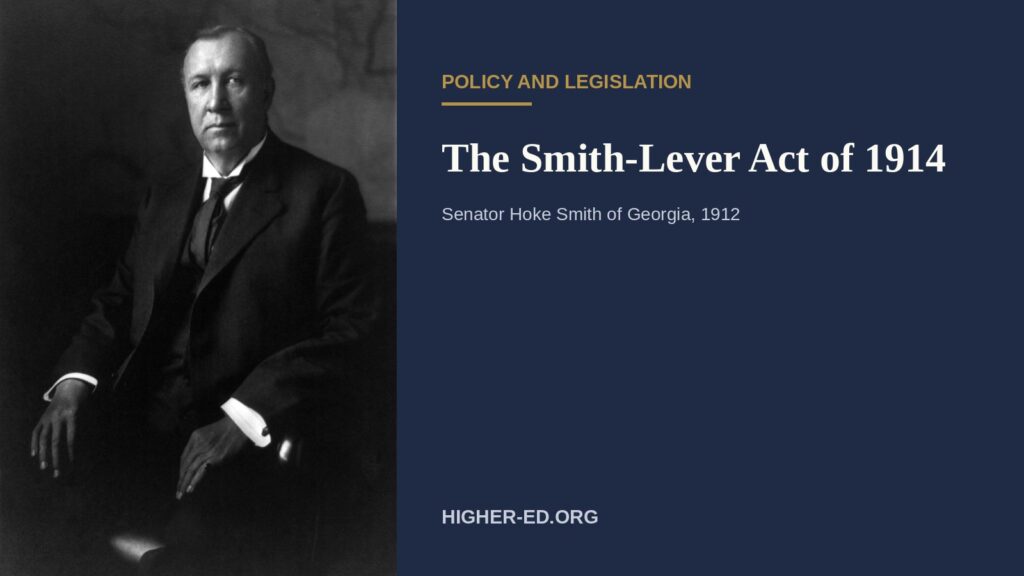
Established in 1914, Cooperative Extension was designed as a partnership of the U.S. Department of Agriculture and the land-grant universities, which were authorized by the Federal Morrill Acts of 1862 and 1890. Legislation in the various States has enabled local governments or organized groups in the Nation’s counties to become a third legal partner in this education endeavor.
The congressional charge to Cooperative Extension through the Smith-Lever Act of 1914 is far ranging. Today, this educational system includes professionals in each of America’s 1862 land-grant universities (in the 50 States, Puerto Rico, the Virgin Islands, Guam, Northern Marianas, American Samoa, Micronesia, and the District of Columbia) and in the Tuskegee University and sixteen 1890 land-grant universities. The provisions of the Act, in effect as of November 28, 1990, are shown below.
Section 1
In order to aid in diffusing among the people of the United States useful and practical information on subjects relating to agriculture, home economics, and rural energy, and to encourage the application same, there may be continued or inaugurated in connection with the college or the colleges in each State, Territory, or possession, now receiving, or which may hereafter receive, the benefits of the Act of Congress approved July second, eighteen hundred and sixty-two, entitled “An Act donating public lands to several States and Territories which may provide colleges for the benefit of agriculture and the mechanic arts,” and of the Act of Congress approved August thirtieth, eighteen hundred and ninety, agricultural extension work which shall be carried on in cooperation with the United States Department of Agriculture: Provided, That in any State, Territory, or possession in which two or more such colleges have been or hereafter may be established, the appropriations hereinafter made to such State, Territory, or possession shall be administered by such college or colleges as the legislature of such State, Territory, or possession may direct.
Section 2
Cooperative agricultural extension work shall consist of the development of practical applications of research knowledge and giving of instruction and practical demonstrations of existing or improved practices or technologies in agriculture, home economics, and rural energy, and subjects relating thereto to persons not attending or resident in said colleges in the several communities, and imparting information on said subjects through demonstrations, publications, and otherwise and for the necessary printing and distribution of information in connection with the foregoing; and this work shall be carried on in such manner as may be mutually agreed upon by the Secretary of Agriculture and the State agricultural college or colleges or Territory or possession receiving the benefits of this Act.
Section 3
There are hereby authorized to be appropriated for the purposes of this Act such sums as Congress may from time to time determine to be necessary.
- (b)(1) Out of such sums, each State and the Federal Extension Service shall be entitled to receive annually a sum of money equal to the sums available from the Federal cooperative extension funds for the fiscal year 1962, and subject to the same requirements as to furnishing of equivalent sums by the State, except that amount heretofore made available to the Secretary for allotment on the basis of special needs shall continue available for use on the same basis.
(2) There is authorized to be appropriated for the fiscal year ending June 30, 1971, and for each fiscal year thereafter, for payment to the Virgin Islands, Guam, and the Northern Mariana Islands, $100,000 each, which sums shall be in addition to the sums appropriated for the several States of the United States and Puerto Rico under the provisions of this section. The amount paid by the Federal Government to the Virgin Islands and Guam pursuant to this paragraph shall not exceed during any fiscal year, except the fiscal years ending June 30, 1971, and June 30, 1972, when such amount may be used to pay the total cost of providing services pursuant to this Act, the amount available and budgeted for expenditure by the Virgin Islands and Guam for the purposes of this Act.
Any sums made available by the Congress for further development of cooperative extension work in addition to those referred to in subsection (b) hereof shall be distributed as follows:
- 1. Four per centum of the sum so appropriated for each fiscal year shall be allotted to the Federal Extension Service for administrative, technical, and other services, and for coordinating the extension work of the Department and the several States, Territories, and possessions.
2. Of the remainder so appropriated for each fiscal year 20 per centum shall be paid to the several States in equal proportions, 40 per centum shall be paid to the several States in the proportion that the rural population of each bears to the total rural population of the States as determined by the census, and the balance shall be paid to the several States in the proportion that the farm population of each bears to the total farm population of the several States ad determined by the census:
Provided, That payments out of the additional appropriations for further development of extension work authorized herein may be made subject to the making available of such sums of public funds by the States from non- Federal funds for the maintenance of cooperative agricultural extension work provided for in this Act, as may be provided by the Congress at the time such additional appropriations are made: Provided further, That any appropriation made hereunder shall be allotted in the first and succeeding years on the basis of the decennial census current at the time such appropriation is first made, and as to any increase, on the basis of decennial census current at the time such increase is first appropriated.
- United States Congress. Original public law or statute reproduced in this entry.
The Federal Extension Service shall receive such additional amounts as Congress shall determine for administration, technical, and other services and for coordinating the extension work of the Department and the several States, Territories, and possessions.
Insofar as the provisions of subsections (b) and (c) of this section, which require or permit Congress to require matching of Federal Funds, apply to the Virgin Islands of the United States and Guam, such provisions shall be deemed to have been satisfied, for the fiscal years ending September 30, 1978, and September 30, 1979, only, if the amounts budgeted and available for expenditure by the Virgin Islands of the United States and Guam in such years equal the amounts budgeted and available for expenditure by the Virgin Islands of the United States and Guam in the fiscal year ending September 30, 1977.
(1) The Secretary of Agriculture may conduct educational, instructional, demonstration, and publication distribution programs through the Federal Extension Service and enter into cooperative agreements with private nonprofit and profit organizations and individuals to share the cost of such programs through contributions from private sources as provided in this subsection.
(2) The Secretary may receive contributions under this subsection from private sources for the purposes described in paragraph (1) and provide matching funds in an amount not greater than 50 percent of such contributions.
Section 4
On or about the first day of October in each year after the passage of this Act, the Secretary of Agriculture shall ascertain as to each State whether it is entitled to receive its share of the annual appropriation for cooperative agricultural extension work under this Act and the amount which it is entitled to receive. Before the funds herein provided shall become available to any college for any fiscal year, plans for the work to be carried on under this Act shall be submitted by the proper officials of each college and approved by the Secretary of Agriculture. The Secretary shall ensure that each college seeking to receive funds under this Act has in place appropriate guidelines, as determined by the Secretary, to minimize actual or potential conflicts of interest among employees of such colleges whose salaries are funded in whole or in part with such funds. Such sums shall be paid in equal quarterly payments in or about October, January, April and July of each to the treasurer of other officer of the State duly authorized by the laws of the State to receive the same, and such officer shall be required to report to the Secretary of Agriculture on or about the first day of April of each year, a detailed statement of the amount so received during the previous fiscal year and its disbursement, on forms prescribed by the Secretary of Agriculture.
SEC.5. If any portion of the moneys received by the designated officer of any State for the support and maintenance of cooperative agricultural extension work, as provided in this Act, shall by any action or contingency be diminished or lost or be misapplied, it shall be replaced by said State, and until so replaced no subsequent appropriation shall be apportioned or paid to State. No portion of said moneys shall be applied, directly or indirectly, to the purchase, erection, preservation, or repair of any building or buildings, or purchase or rental of land, or in college-course teaching, lectures in college, or any other purpose not specified in this Act. It shall be the duty of said colleges, annually, on or about the first day of January, to make the Governor of the State in which it is located a full and detailed report of its operations in extension work as defined in this act including a detailed statement of receipts and expenditures from all sources for this purpose, a copy of which report shall be sent to the Secretary of Agriculture.
Section 6
If the Secretary of Agriculture finds that a State is not entitled to receive its share of the annual appropriation, the facts and reasons therefor shall be reported to the President, and the amount involved shall be kept separate in the Treasury until the expiration of the Congress next succeeding a session of the legislature of the State from which funds have been withheld in order that the State may, if it should so desire, appeal to Congress from the determination of the Secretary of Agriculture. If the next Congress shall not direct such sum to be paid, it shall be covered into the Treasury.
Section 7
Repealed. (Dealt with an annual report to Congress.)
Section 8
The Congress finds that there exists special circumstances in certain areas which cause such areas to be at a disadvantage insofar as agricultural development is concerned, which circumstances include the following:
There is concentration of farm families on farms either too small or too unproductive or both;
such farm operators because of limited productivity are unable to make adjustments and investments required to establish profitable operations;
the productive capacity of the existing farm unit does not permit profitable employment of available labor;
because of limited resources, many of these farm families are not able to make full use of current extension programs designed for families operating economic units nor are extension facilities adequate to provide the assistance needed to produce desirable results.
In order to further the purposes of section 2 in such areas and to encourage complementary development essential to the welfare of such areas, there are hereby authorized to be appropriated such sums as the Congress from time to time shall determine to be necessary for payments to the States on the basis of special needs in such areas as determined by the Secretary of Agriculture.
In determining that the area has a special need, the Secretary shall find that it has a substantial number of disadvantaged farms or farm families for one or more of the reasons heretofore enumerated. The Secretary shall make provisions for assistance to be extended to include one or more of the following.
Intensive on-the-farm educational assistance to the farm family in appraising and resolving its problems;
assistance and counseling to local groups in appraising resources for capability of improvement in agriculture or introduction of industry designed to supplement farm income;
cooperation with other agencies and groups in furnishing all possible information as to existing employment opportunities, particularly to farm families having underemployed workers; and
in cases where the farm family, after analysis of its opportunities and existing resources, finds it advisable to seek a new farming venture, the providing of information, advice, and counsel in connection with making such change.
No more than 10 per centum of the sums available under this section shall be allotted to any one State. The Secretary shall use project proposals and plans of work submitted by the State Extension directors as a basis for determining the allocation of funds appropriated pursuant to this section.
Sums appropriated pursuant to this section shall be in addition to, and not in substitution for, appropriations otherwise available under this Act. The amounts authorized to be appropriated pursuant to this section shall not exceed a sum in any year equal to 10 per centrum of sums otherwise appropriated pursuant to this Act.
Section 9
The Secretary of Agriculture is authorized to make such rules and regulations as may be necessary for carrying out the provisions of this Act.
SEC.10. (1) The term “State” means the States of the Union, Puerto Rico, the Virgin Islands, Guam, and the Northern Mariana Islands.
(Code reference is 7 U.S.C. 341 et. seq.)
Sources
Corrections are welcome via the contact page.
Next entryNational Sea Grant College and Program Act of 1966→